The basic argument of an atheist is “If there is a God then prove it, where is the evidence? I can’t see him, I’ve never seen a miracle, there is no evidence of supernatural powers or beings.” Replace those words with aliens and you get the exact same argument. Anyone who argues against the existence of God has to give the exact same arguments against the existence of aliens.
I’m in the opposite category, despite my faith I say “There are no aliens in this galaxy, prove me wrong.” It’s unreasonable to say that even one other intelligent species evolved in our galaxy because that requires wild coincidences about why they aren’t here. Some of those coincidences say:
1 They evolved at almost exactly the same time as we did (beating the odds of 13 billion to one)
2 they aren’t explorers, they just stayed home, and they never sent out robotic exploration ships
3 they killed themselves (war, suicide, plague) before launching robotic exploration machines
4 they all died because of natural events (asteroids, supernovae, plague) before launching robotic exploration machines
5 their robots came and left before we noticed and left no evidence of their visit, and are probably secretly watching us
6 they have a Prime Directive and they won’t visit us until x happens …. and maybe never
Many people confuse the evolution of life with the evolution of intelligent life. They say life evolves easily and that life is everywhere in our galaxy, but they are not talking about intelligent life, they are talking about bacteria. The Rare Earth explanation for the Fermi Paradox is not about planets, it’s not about atmospheres, and it’s not about bacteria. It’s about space faring sentient life. I could not care less if there are bacteria in every stellar system in this galaxy. That is boring and has nothing at all to do with the Fermi Paradox.
The evolution of intelligent life is rare, extremely rare. So rare that the rate per galaxy is well below 1.0 per 13 billion years. If FTL is possible then the Fermi Paradox requires that the rate of evolution of intelligent life is about once in 13 billion years per universe. That means we are alone in the entire universe.
Prove me wrong with evidence, not conjecture. Don’t tell me what “we all know to be true” especially all you atheists, because you won’t accept that argument for the existence of God.
10 responses so far ↓
1 makarios // Sep 20, 2009 at 8:38 pm
the only thing that atheists know for sure is that God does not exist. they’ll even invent dozens of atheist origin of the universe mythologies rather than consider the supernatural.
2 Sean // Sep 20, 2009 at 9:29 pm
Thanks for the comment. Most people believe what they believe, don’t believe what they don’t believe, and aren’t really capable of explaining it, or applying a consistent method of analyzing everything else in the world.
3 Colum Paget // Mar 2, 2010 at 4:42 am
No, you misunderstand the atheist position, I think. If someone asserts that ‘god does not exist’, then they are asserting a faith-based position. Most atheists are really agnostic, they have to admit that god *might* exist, but given that there is a paucity of evidence for her existance, we have to proceed as though she doesn’t. However, I don’t think that most atheists mind people personally believing that god does exist, what they mind is believers trying to enforce that belief onto others, and write it into the laws of society.
There is also the problem of *which* god exists. The argument from design is usually used to support the existance of a *particular* creator, but this is akin to finding a ten-pound note in the street, and asserting “Ah! My mate Bill said he lost ten pounds, this must be it!”
Most atheists, when pressed, would have to admit that logically some form of creator (or more likely team of creators) might exist, and might have built this universe. However, current evidence, and the application of occam’s razor would lead one to disregard this possiblity until good evidence appeared to support it.
The situation with aliens is similar, but with one minor difference. On the basis of what we know about biology, and given the incredible scale of the universe, there *should* be intelligent life elsewhere. If there is not, then we will have to re-adjust our scientific theories, though as of yet no-one knows which bits will need re-adjusting.
Colum
4 Colum Paget // Mar 2, 2010 at 5:05 am
As regards arguments for aliens, against arguments for god, the issue is that aliens can be fitted into our current scientific frameworks, in fact those frameworks demand the existence of intelligent life elsewhere. However, those frameworks do not demand the existence of a cosmic creator/s, though s/he/they may exist. If ever a consistent scientific theory appeared that *demanded* the existence of a creator (and in the past we thought we had these, but further exploration undermined them) then large numbers of people would switch to beleving that there was such a creator. This may yet happen, there is plenty that needs to be explained, and plenty of scientific work to be done, we may yet find something that proves the existence of a creator/s.
I used to be a big fan of the fermi paradox myself, but as I’ve grown older I’ve come to feel that it’s hopelessly unrealistic. The fermi paradox thinks that it’s likely that there will be advanced civilisation in our vicinity at the same time as advanced civilisation arises on earth. I think this is fabulously unlikely. Consider this question:
Where do you think the human race will be 100 years from now?
Do you think we’ll be on mars, living there? I used to, but now I don’t. There isn’t the public support to do this, and pretty soon the cheap fuel sources are going to be used up, so it will get harder to get there. Furthermore the likelyhood of a civilisational crash is very great, all the great civilisations of history crashed at some point, and on that basis we should expect that to happen to ours. A smart move would be to build ‘civilisation arks’ that we can store our knowledge in, so that people post-crash can pick up where we left off. But I don’t think we’ll do that either, so when we do crash, most of our knowledge will be lost.
As for the cause of the crash, choose your poison. There are so many things that are likely to go wrong, that even if this one doesn’t get you, the next one will. If its not the collapse of oil, the burgeoning population, the ozone layer, global warming, geomagnetic flip, biological terrorism, water shortage, asteriod strike, etc, etc, etc, it will surely be *something*.
How long has our society been detectable by the aliens? Maybe 100 years, if we allow that early radio transmissions are detectable across light years (Which I personally doubt). Therefore, throughout the billions of years that the earth has existed, there has been no evidence for life in the solar system, from the point of view of outsiders. If our time as an advanced civilisation is short, and it’s likely to be, given what happend in the past, then anyone who blinks will miss us.
As for building self replicating probes, this will never happen. Where will the budget come from? Imagine the public outcry against doing such a thing? What’s your twenty year payback on it? How can you take money out of healthcare to spend on such folly? What about the health-and-safety implications?
Why then, would aliens do it? They won’t. We won’t either. If I see us living (not just visiting, living) on Mars in my lifetime, I’ll be amazed. If someone from the future came back and told me that we never did it, I wouldn’t be surprised (Well, I’d be surprised at the time travel!)
Colum
5 Sean // Mar 2, 2010 at 2:21 pm
No legitimate scientific theory demands the existence of intelligent aliens. This is the SETI version of Lamarckian evolution.
You have a 21st century view of the cost of building robotic probes. Think singularity: self replicating nanoprobes sent to explore the universe might only cost a few dollars each in a hundred years.
6 Sean // Mar 2, 2010 at 2:32 pm
I don’t have beliefs about biology, I look at the facts. There is no physical evidence that intelligent life evolved more than once in our galaxy.
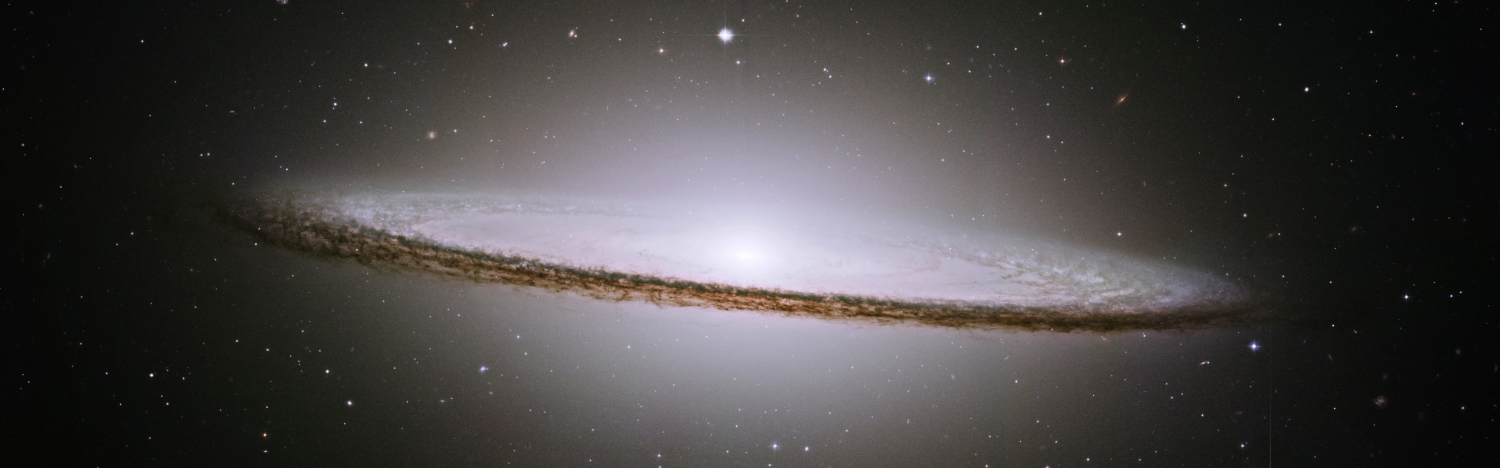
When I look at pictures of M101 and M31 I see no evidence for galactic scale constructs implying that there never were any intelligent beings in those galaxies. That is overwhelming physical evidence that intelligent life has evolved once in the history of the entire galaxy.
7 Colum Paget // Mar 2, 2010 at 7:53 pm
Galactic scale constructs?!!
Oh, I think you are having fun at my expense now.
Ah well, why not.
You do realise you’ve just disproved the existence of the human race? Looking out into the milky way, we see no evidence of ‘galactic scale constructs’. Therefore there is no intelligent life in our local galaxy! Going further, we do not even see evidence of planentary scale constructs in the solar system! No dyson sphere, so clearly there is no intelligent life. I mean, a dyson sphere is a lot less effort than a galactic scale structure? We should at least see that!
Turning your argument around, an alien in either of M101 or M31 could use your argument to say that there was overwhelming physical evidence that we don’t exist, because we’ve built nothing that can be seen from the next star-system, let alone the next galaxy (I assume our radio transmissions can be picked up at the next star-system. Hmm… maybe not, my wifi has enough trouble working in the next room!).
There is no physical evidence that intelligent life evolved more than once in the galaxy, this is true, but it is likely. The current best theories we have predict this, just as once there was no evidence for planets round other stars, but the theories we had predicted that. Black holes were theoretical too once, they kinda still are in fact, I think they can’t very easily be directly observed, so we tend to see effects and say “There’s probably a black hole in the center of that”, but we can’t be sure, it might be something else. But black-holes are pretty much predicted by our current theories.
There is no overwhelming physical evidence either way. Since we are barely able to see planets around nearby star-systems with our current level of technology, we cannot state that there is ‘overwhelming evidence’ against aliens either. We just don’t have the evidence, except for a bunch of theories that say it’s likely they exist (those theories might be wrong, but they’re the best we have at the moment).
8 Colum Paget // Mar 2, 2010 at 8:09 pm
> No legitimate scientific theory demands
> the existence of intelligent aliens.
I suspec this is untrue, though it might not be, but I feel quite strongly that it is. Maybe I’ll have to think more about it.
The reason that I think it’s untrue is that it is a central tenet of all our scientific theories that the rules of nature are broadly constant across the entire universe, for instance, the speed of light (in a vacuum) is not thought to be different at andromeda, than it is here. This means that the laws of biology and chemistry are thought to be similar throughout the galaxy. Given this, and given that evolution is thought to lead generally to greater complexity, and given that intelligence is thought to have a survival benefit, we should encounter intelligent life.
Of course, one of those presumptions could be wrong. The most likely one to my mind is that intelligence has a survival benefit. Maybe in the long term, it doesn’t. Having said that though, that would mean that the aliens existed, but suicided.
If intelligence has *never* arisen elsewhere, then why do you think that life has arisen elsewhere? There’s no evidence for this either (outside of the fact that our theories predict it). It could be that life is the incredibly rare event. Maybe the whole galaxy, the whole universe of trillions of star-systems, is sterile.
However, given the vast numbers of star-systems out there, I think this is rather unlikely.
9 Colum Paget // Mar 2, 2010 at 8:21 pm
> You have a 21st century view of the cost of
> building robotic probes. Think singularity:
> self replicating nanoprobes
Ah… the singularity. I can’t decide if this is predicted by our theories, or not. What I do know is that we’ve already had singularities, rather a lot of them. When we harnessed fire, that was one. No one could imagine what the post-fire world was going to be like. Every major technological advance has been a singularity. But we’re still stuck here on good old earth. If you had a time machine, went back to the 60’s and told Arthur C Clarke, Issac Asimov and all that crowd “I’ve come from 2010, and all this stuff you’re writing about, colonies on the worlds and Artificial Intelligence, IT NEVER HAPPENED” (if you have a time machine, you shouldn’t do this, because it’s mean), I wonder what they’d say. I think they’d refuse to believe you. We, like them, assume that all the stuff we think is going to come after the next singularity is actually going to happen. But we’ve no hard evidence for any of this, this too is speculation.
I do think that self-replicating nano-bots are possible. Here’s a thought experiement for you. There’s a crazy guy down the road who’s been doing some experiements with these, and has gotten them to work. You’ve seen evidence that he’s gotten them to work. He says he’s going to release them into the local environment, and that they will set about making their way out into space by first building structures that will take them off Earth.
How do you feel about that? What happens next?
I grant you though, someone should probably have been stupid enough to do it. Maybe *that’s* why the galaxy is sterile.
Colum
10 Phaedrus // Jul 9, 2010 at 3:24 pm
Atheists are making a belief claim based on an alarming amount of evidence against the existence of a *defined* god (usually the judeo-christian god), and an extraordinary amount of evidence confirming competing theories that have absolutely no need for a deity (evolution, big bang, quantum mechanics, etc..). And by the way, evolution is happening all the time. In fact we can watch it happen with bacteria, and we can use the concept of natural selection to produce species through artificial selection (dogs, cats, seedless watermelon, the banana’s we currently eat – which were naturally not so edible). Humans don’t seem to evolve because we defy natural selection through our social contract (medical programs, well-fair, etc. – there’s no survival of the fittest because we help the physically weak). That’s why humans have so many diseases while lion’s in Africa, etc., don’t seem to have any.
It’s okay to have a belief claim as long as the conclusions you have reached are based in empirically adequate evidence and sound reasoning. This is the difference between a theist and an atheist.
Now as an Atheist myself, I still realize this is a belief claim reached by reason and evidence, but this still doesn’t mean I possess an objective truth. I *might* have a justified TRUE belief, but I will never know it. I can only determine that I have justified that belief in a competent way. I realize however that it’s possible that evidence might be discovered that alter that belief. It’s always a possibility, but not always a plausibility.
As far as Aliens existing. It’s another positive claim, where the burden of proof is on the one making the claim. And what can be introduced without evidence can be dismissed without evidence by the same logical justification. I think it is certainly possible there is intelligent life out there, but virtually impossible that there is a God (as defined by the monotheists) based on all evidence and argument to the contrary.
I will agree that the claim “there is no alien life” is less founded than “there is no god” because alien life would leave evidence of existence (because aliens supposedly exist within a reality). This means we could create testable/falsifiable hypothesis as our technology progresses (our ability to explore the universe). If we ever did gather significant evidence of alien life that would push us through the door of reasonable doubt, our space program would take off within months toward an end of discovering more.
Leave a Comment